Key takeaways
- For four phones and two lamps, 72 hours takes about 650 Wh, which a station of about 770 Wh covers.
- Keeping the internet router on all three days raises the total to about 2,100 Wh, so a 2,000 Wh station lasts about 2.5 days.
- Running a fridge nonstop for 72 hours needs over 6,000 Wh, so most households run it in blocks or rely on a closed freezer.
- A power station adds to the official kit; it does not replace the flashlight, radio, water and spare batteries.
In this article
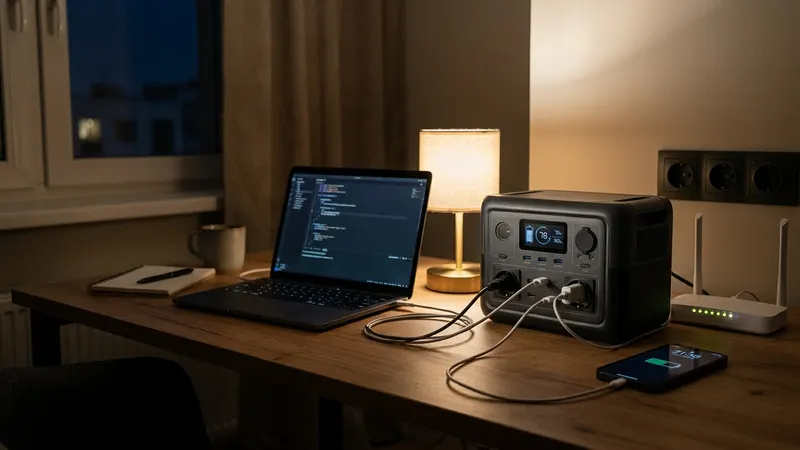
For a household of four, keeping phones and two lamps going for 72 hours takes about 650 Wh, so a station of about 770 Wh does the job. Add the internet router all three days and the total climbs to about 2,100 Wh, which a 2,000 Wh station covers for about two and a half days. A fridge running nonstop is out of reach for most portable stations, so plan it differently.
What the official kit already asks for
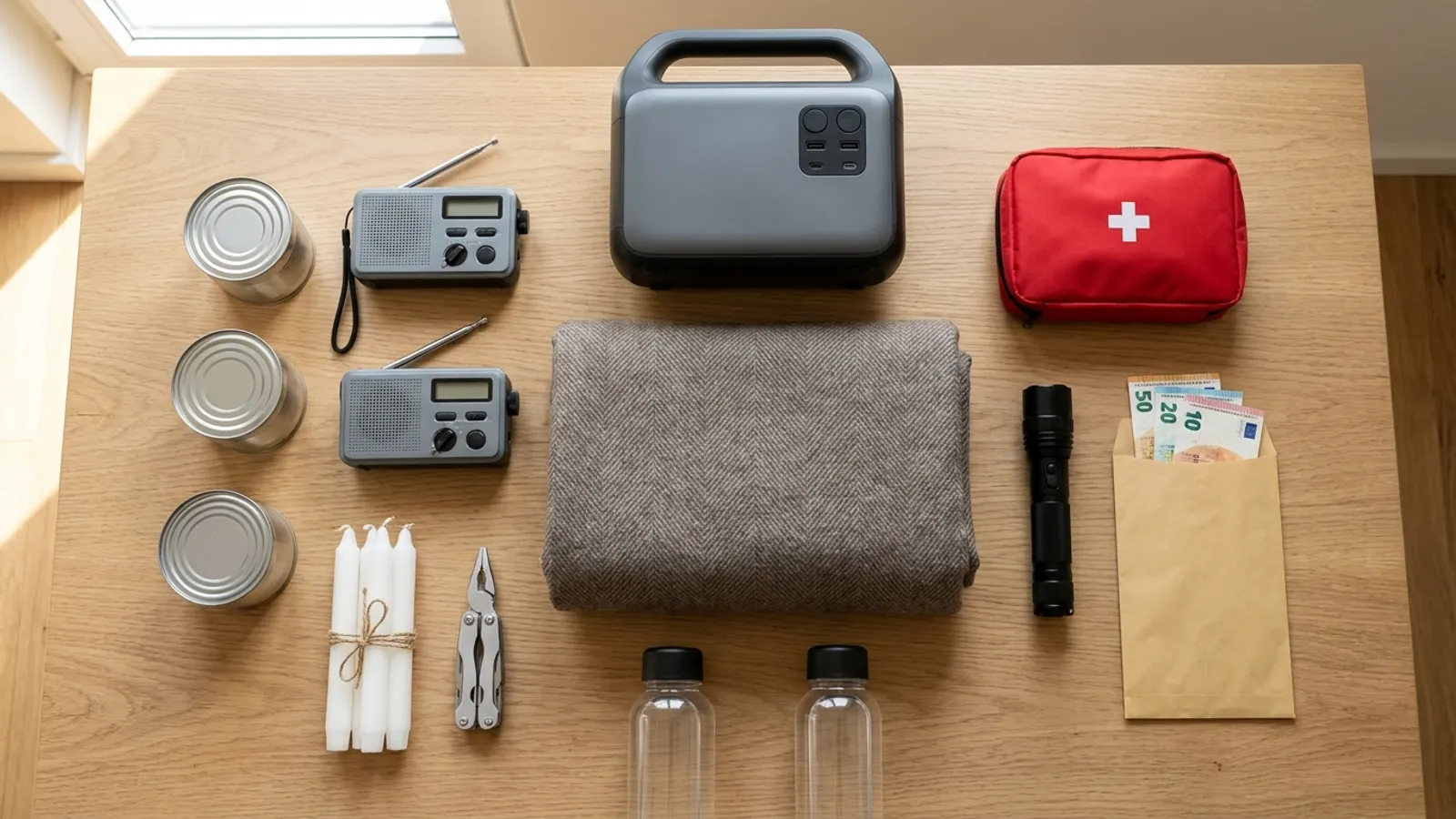
The Government of Canada asks households to be able to take care of themselves for at least 72 hours. Its checklist includes:
- about four litres of water per person per day, for drinking, cooking and washing
- non-perishable food and a manual can opener
- a flashlight and a radio, with spare batteries or crank versions
- a mobile phone charger and a power bank
- a first aid kit, cash in small bills and spare keys
- prescriptions and any medical equipment someone needs
A power station is not on that list, and it does not replace any of it. It is an upgrade for households that want to keep a few devices running, not just phones.
Three levels of power for 72 hours
Here are three levels for a family of four. Watts come from our site averages: phone charging 10 W for 3 hours, LED lamp 8 W, router 10 W, fridge 45 W on average.
Phones and lamps can run from USB, so the station’s outlets stay off. As soon as you plug something into an outlet, we add 10 W for the station’s own use while its outlets are on.
| Level | What runs | Wh per day | Wh for 72 h |
|---|---|---|---|
| 1. Lights and phones | 4 phones (4 × 30) + 2 lamps 6 h (2 × 48) | 216 | 648 |
| 2. + Internet | Level 1 + router 24 h on an outlet: (10 + 10) × 24 | 696 | 2,088 |
| 3. + Fridge | Level 2 + fridge 24 h: 45 × 24 | 1,776 | 5,328 |
To turn that into battery size, divide by 0.85, since about 15 % is lost along the way. Level 1 needs 648 ÷ 0.85 ≈ 760 Wh, Level 2 about 2,460 Wh, and Level 3 about 6,270 Wh.
What each size of station covers
To get the number of days, multiply the battery Wh by 0.85 and divide by the daily need. Capacities are announced by the brands.
| Station | Usable Wh | Level 1 (216 Wh/day) | Level 2 (696 Wh/day) | Level 3 (1,776 Wh/day) |
|---|---|---|---|---|
| BLUETTI EB3A (268 Wh) | ≈ 228 | ≈ 1 day | ≈ 8 hours | ≈ 3 hours |
| EcoFlow RIVER 2 Pro (768 Wh) | ≈ 653 | ≈ 3 days | ≈ 0.9 day | ≈ 9 hours |
| FOSSiBOT F2400 (2,048 Wh) | ≈ 1,741 | ≈ 8 days | ≈ 2.5 days | ≈ 1 day |
Example: the RIVER 2 Pro holds 768 × 0.85 ≈ 653 Wh, and 653 ÷ 216 ≈ 3 days. That matches the 72-hour goal for Level 1.
You can build your own household list in the runtime calculator.
The fridge question
A fridge is the hardest item to carry for three days. At 45 W average it uses 1,080 Wh a day, more than a 1,000 Wh station holds.
Most households get by without powering it the whole time. Canada.ca advises keeping the fridge and freezer closed unless absolutely necessary, and says a closed freezer keeps food frozen for 24 to 48 hours.
A practical routine on a 2,000 Wh station: run the fridge a few hours in the morning and a few in the evening, and keep the door shut in between. See the fridge on the FOSSiBOT F2400 for the numbers on that model.
Staying connected
Innovation, Science and Economic Development Canada (ISED) recommends plugging your home router into an uninterruptible power supply, and keeping a portable backup power supply for wireless devices. A power station can play both roles.
ISED also suggests:
- using a wired phone, if you have one, for 911 calls
- sending texts instead of calls when networks are busy
- turning on power-saving mode to stretch phone batteries
- watching out for carbon monoxide if you charge a phone in a car, especially in an enclosed space
Remember that your internet only works if your provider’s network still has power. Your router on a station is one part of the chain.
A radio that runs on batteries or a hand crank is still the most reliable way to hear local news, and it costs the station nothing. Keep it in the kit with spare batteries.
Keeping the station ready
A station is only useful if it is charged when the outage starts. Canada.ca suggests checking your kit at the spring and fall time changes; top up the station at the same time.
Store it in a heated part of the home, not a cold garage. Check the charging temperature in your manual; our guide to charging below 0 °C explains why. Never plug a station into a wall outlet to feed the house, and don’t connect it to your home’s wiring. For the rest of the list, see our 72-hour emergency kit page.
In short
- Phones and lamps for four people over 72 hours take about 650 Wh.
- Adding the router for three days takes about 2,100 Wh, about 2.5 days on a 2,000 Wh station.
- A fridge running nonstop for 72 hours needs over 6,000 Wh, so run it in blocks.
- Check and charge the station when the clocks change, along with the rest of the kit.
Sources
Questions
What does the Government of Canada say to put in a 72-hour kit?
Water (about four litres per person per day, for drinking, cooking and washing), non-perishable food, a manual can opener, a flashlight, a radio, a phone charger and power bank, a first aid kit, cash, spare keys and any medication or medical equipment.
Is a power bank enough, or do I need a power station?
A power bank covers phones. A power station also runs a router, lamps, a CPAP or, for a while, a fridge. Pick by what you want to keep running.
How often should I check the station?
Canada.ca suggests checking your kit when the clocks change in spring and fall. That is a good time to top up the station too.
Can I run the station from a car to recharge it?
Yes, through the 12 V socket while the engine runs, outdoors. ISED warns about carbon monoxide from cars, especially in enclosed spaces, so never do it in a garage.
Stations in this article
- 768 Wh · 800 W EcoFlow RIVER 2 Pro Every device with the EcoFlow RIVER 2 Pro768 Wh Check price
- 2048 Wh · 2400 W FOSSiBOT F2400 Every device with the FOSSiBOT F24002,048 Wh Check price
- 268 Wh · 600 W BLUETTI EB3A Every device with the BLUETTI EB3A268 Wh Check price
How much battery do you need?
Tick your devices and how long you need to last. The calculator gives you the answer in 30 seconds.
Open the calculator