Key takeaways
- Without a cool box, a campervan day of lights, two phones and a bit of laptop takes about 240 Wh, so a 768 Wh station lasts a weekend easily.
- A compressor cool box adds about 360 Wh a day, which pushes a weekend to around 1,200 Wh.
- A 100 W panel lying flat on the roof gives roughly 300 to 400 Wh on an average July day in Britain, and far less in October.
- Strap the station down while driving, and leave anything wired into the van to a qualified professional.
In this article
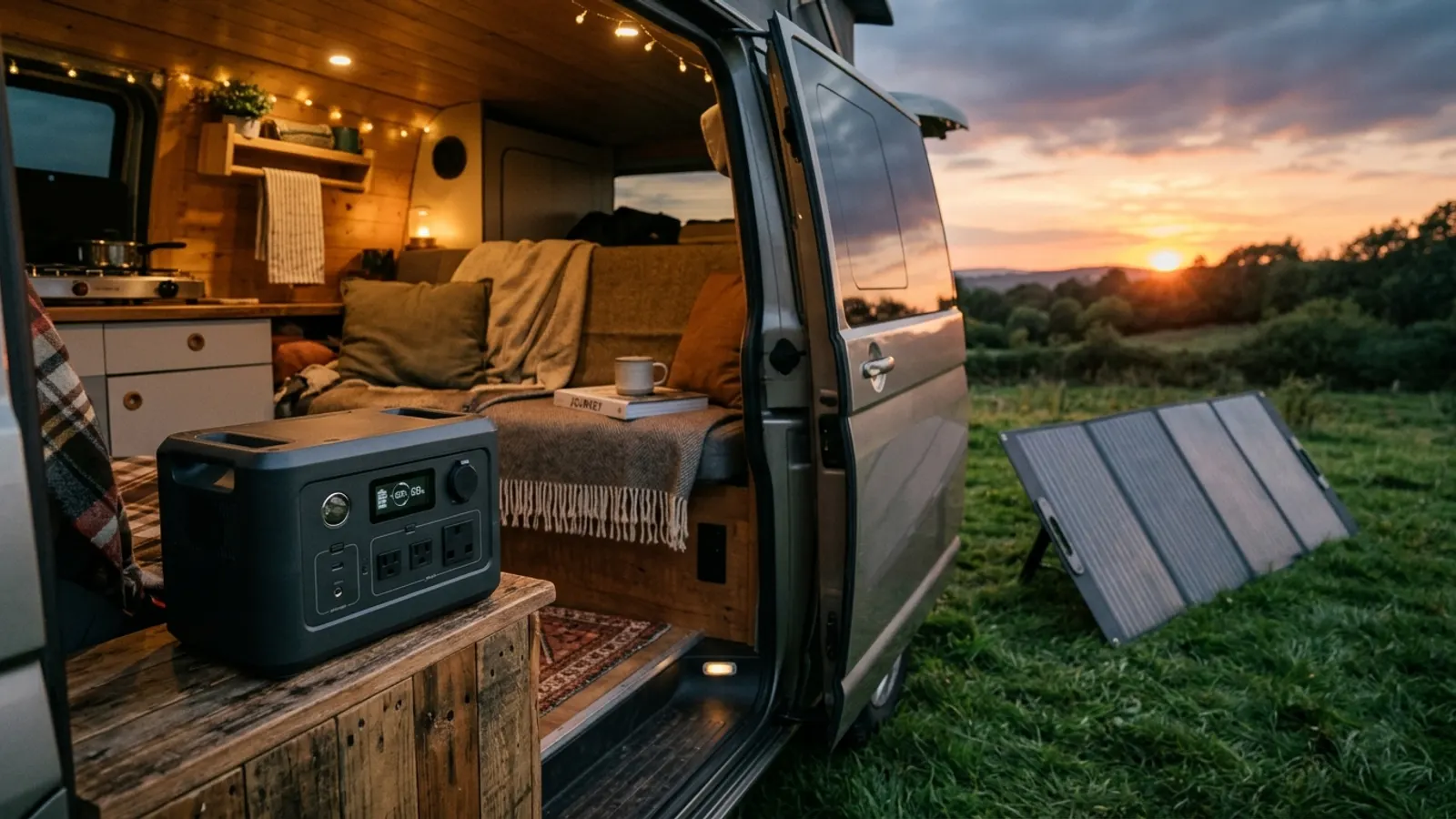
For a weekend in a campervan without a hook-up, a station of about 700 to 1,000 Wh is enough. Without a cool box you will come home with charge to spare. With a 12 V compressor cool box running day and night, you need about 1,000 Wh plus a little sun, or a hook-up on one of the nights.
What a campervan weekend actually uses
Here we count two days and two nights: Friday evening to Sunday afternoon. Here is a typical day, with our site averages and a cool box figure based on the maker’s data:
| Device | Watts | Hours a day | Wh a day |
|---|---|---|---|
| Compressor cool box (12 V socket) | 15 W average | 24 h | 360 Wh |
| LED lamp (USB or 12 V) | 8 W | 5 h | 40 Wh |
| Two phones (USB) | 10 W each | 3 h | 60 Wh |
| Laptop (230 V socket) | 60 W + 10 W for the station | 2 h | 140 Wh |
| Total with cool box | 600 Wh | ||
| Total without cool box | 240 Wh |
The maths: 15 × 24 = 360, 8 × 5 = 40, 10 × 3 × 2 = 60, (60 + 10) × 2 = 140. Add them and you get 600 Wh.
Why the cool box is the big one
A compressor cool box only runs its motor some of the time. Dometic gives 0.98 Ah per hour at 12 V for its CFX3 35, measured with 32 °C outside. That is about 12 W on average (0.98 × 12). We use 15 W to leave a margin for a warm van and frequent opening.
It runs all day and night, so it uses more than everything else put together. Over the 12 V socket the station does not need its 230 V sockets switched on, so we leave out the extra 10 W for that line.
How long three stations last
Our runtime rule is battery Wh × 0.85, the share you can really use once losses are taken off. Then divide by what you use per day.
| Station (battery announced by the brand) | Usable Wh | Days with cool box (600 Wh) | Days without (240 Wh) |
|---|---|---|---|
| EcoFlow RIVER 2 Pro (768 Wh) | ≈ 653 Wh | ≈ 1.1 days | ≈ 2.7 days |
| Anker SOLIX C1000 (1,056 Wh) | ≈ 898 Wh | ≈ 1.5 days | ≈ 3.7 days |
| Jackery Explorer 1000 v2 (1,070 Wh) | ≈ 910 Wh | ≈ 1.5 days | ≈ 3.8 days |
Example: 1,056 × 0.85 = 897.6 Wh, and 897.6 ÷ 600 ≈ 1.5 days.
So without a cool box, any of the three gets you through the weekend from a full charge. With the cool box, even the 1 kWh models run out on Sunday morning unless you top up. To try your own list, use the runtime calculator.
What a roof panel adds in a British summer
A solar panel never gives its full watt rating for long. The European Commission’s PVGIS tool estimates what a panel actually produces, place by place and month by month. For a panel lying flat, like one on a van roof, it gives these daily figures per kW of panels, after typical system losses:
| Place | June | July | October |
|---|---|---|---|
| Birmingham | 3.98 kWh | 3.87 kWh | 1.32 kWh |
| Fort William | 3.29 kWh | 3.04 kWh | 0.80 kWh |
A 100 W panel is a tenth of a kW. So in Birmingham in July it gives about 3.87 × 100 = 387 Wh a day on average, and about 130 Wh in October. In the west Highlands, count on less.
These are averages over many years. A grey, wet weekend can give a fraction of this, and parking under trees cuts it further.
Does that close the gap?
With the cool box, a weekend needs about 1,200 Wh. A full Anker SOLIX C1000 gives about 898 Wh. Two July days with a 100 W panel add roughly 700 to 800 Wh, so you finish with charge left over. In October the same panel adds only about 260 Wh over two days, which is not enough on its own.
Check the solar input each brand announces: 220 W for the RIVER 2 Pro, 400 W for the Jackery Explorer 1000 v2 and 600 W for the Anker SOLIX C1000. A 100 W or 200 W panel fits all three.
Practical points for the van
Weight and space
The brands announce 7.8 kg for the RIVER 2 Pro, 10.8 kg for the Jackery Explorer 1000 v2 and 12.9 kg for the Anker SOLIX C1000. In a small van, the lighter box is easier to move from the cab to the table to the tent.
Strap it down
A 10 kg box that slides under braking is dangerous. Wedge it in a cupboard or use a strap fixed to a proper anchor point.
Charging while driving
The 12 V socket in the cab charges slowly, and the speed depends on the station and the vehicle. It helps, but do not count on it to refill a big station on a short drive. Anything wired into the van’s own electrics, like a split charge system or a fixed battery, is a job for a qualified professional.
To compare two of these models side by side, see RIVER 2 Pro vs Jackery Explorer 1000 v2, or open the EcoFlow RIVER 2 Pro page.
In short
- Without a cool box, a campervan weekend takes about 240 Wh a day, and a 768 Wh station is plenty.
- A compressor cool box adds about 360 Wh a day and doubles what you need.
- In a British July, a 100 W flat panel gives roughly 300 to 400 Wh a day on average; in October, about a third of that.
- Strap the station down and leave fixed wiring to a professional.
Sources
Questions
Do I need a hook-up for a weekend in a campervan?
Not if you keep to lights, phones and a little laptop use. A 768 Wh station covers that for more than two days. A cool box is what makes a hook-up, a bigger station or a solar panel worth having.
Can I charge a power station from the van's 12 V socket?
Yes, most stations come with a car charging cable. It is slow, and the speed depends on the station and the socket, so check the manual. Do not wire a station into the van's electrics yourself.
How much does a solar panel give in the UK?
Far less than its watt rating suggests. EU PVGIS data for the Midlands gives about 3.9 kWh per kW of flat panel per day in July, so about 390 Wh for a 100 W panel, and about 130 Wh in October. Cloud and shade cut that further.
Is a 1 kWh station too heavy for a small van?
The brands announce 10.8 kg for the Jackery Explorer 1000 v2 and 12.9 kg for the Anker SOLIX C1000. The EcoFlow RIVER 2 Pro is 7.8 kg. Whatever you choose, it must be strapped or wedged so it cannot slide.
Stations in this article
- 768 Wh · 800 W EcoFlow RIVER 2 Pro Every device with the EcoFlow RIVER 2 Pro768 Wh Check price
- 1070 Wh · 1500 W Jackery Explorer 1000 v2 Every device with the Jackery Explorer 1000 v21,070 Wh Check price
- 1056 Wh · 1800 W Anker SOLIX C1000 Every device with the Anker SOLIX C10001,056 Wh Check price
How much battery do you need?
Tick your devices and how long you need to last. The calculator gives you the answer in 30 seconds.
Open the calculator