Key takeaways
- Utilities can cut power to reduce wildfire risk, and PG&E says these shutoffs may last several hours or several days.
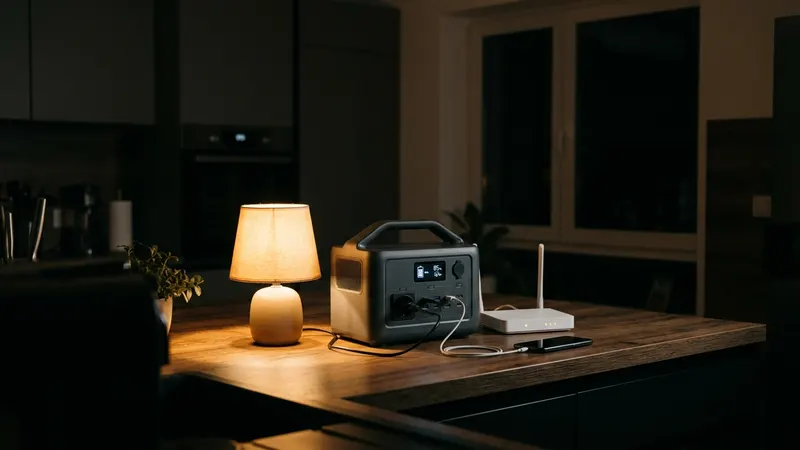
- A station of about 1,000 Wh keeps a router and phones going for well over a day.
- Adding the fridge for half the day brings the same station down to about 20 hours, so plan the fridge in blocks.
- Sign up for your utility's alerts, and ask about Medical Baseline if someone at home relies on powered medical equipment.
In this article
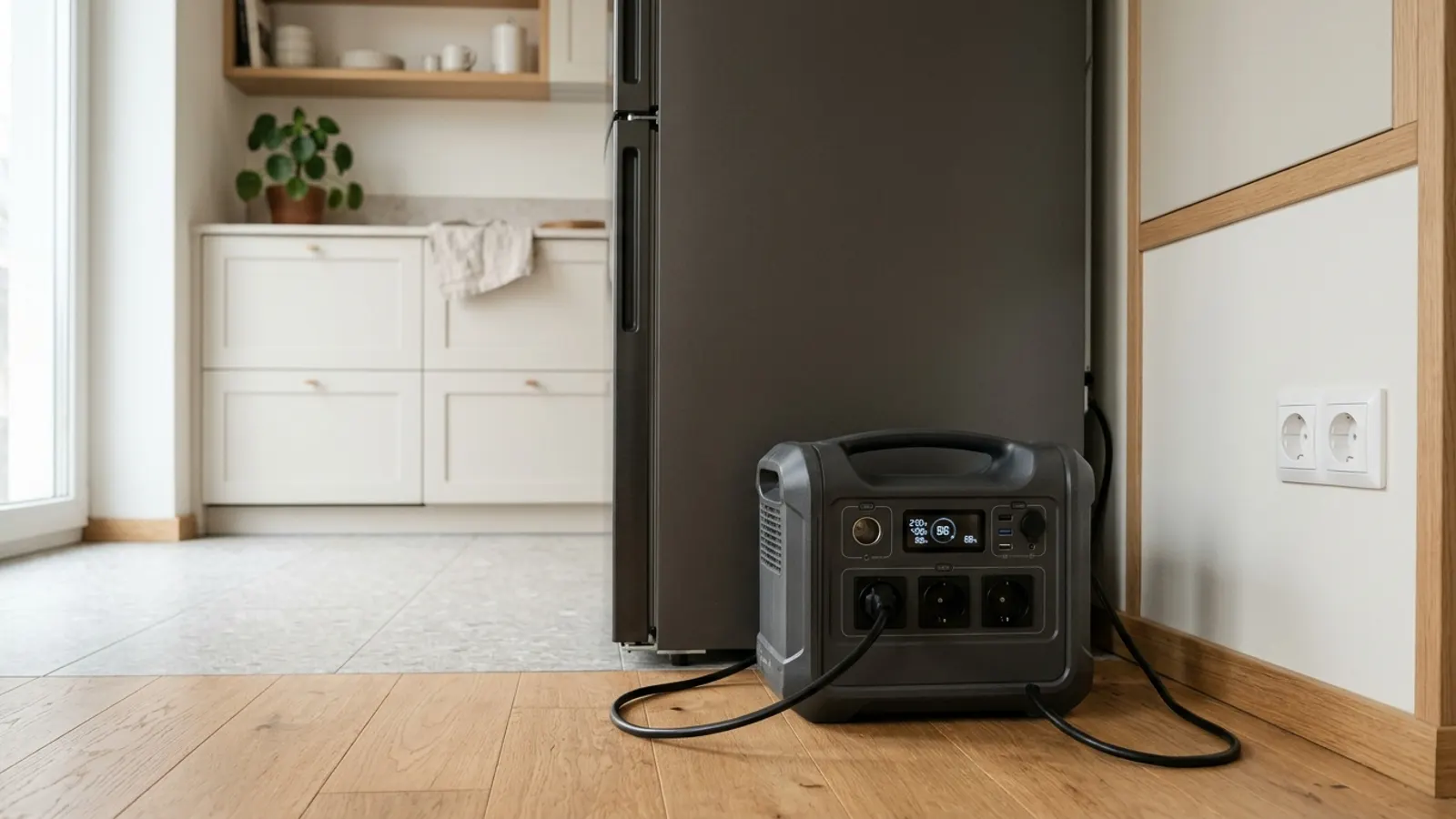
During a Public Safety Power Shutoff, a portable power station of about 1,000 Wh can keep your router and phones on for more than a day, and your fridge cold for part of each day. The trick is to run the router all the time and the fridge in blocks. Here is how to plan it.
What a PSPS is
The California Public Utilities Commission explains that utilities may turn off power to specific areas to reduce the risk of fires started by power lines. It is meant as a last resort, used when strong winds or dry conditions create a serious wildfire risk.
PG&E says these outages may last several hours or several days, depending on the weather and the time needed to check the lines and restore power safely. It also says the first alert may sometimes come the same day the power goes off.
So the station has to be charged before you get the alert. During fire-weather season, keep it full and plugged in.
The two things worth powering
Internet
A router or modem uses about 10 W on average. That small load is easy to carry for a long time, and it keeps you connected to alerts, work and family.
One limit: your internet provider’s equipment outside your home also needs power. If it goes down, your router will not bring the internet back. Keep your phone charged so you can use it as a hotspot.
The fridge
On this site we count 45 W on average for a fridge, with a burst of about 700 W when its motor starts. All three stations here announce at least 1,500 W of output, which covers that start.
The fridge is the big user. Running it nonstop uses most of a 1,000 Wh station in less than a day.
How long a 1,000 Wh station lasts
Our runtime formula is: hours = battery Wh × 0.85 ÷ (device watts + 10 W). The 0.85 covers the energy lost making household current, and the 10 W is what the station uses with its outlets on.
For a whole day, add up each device’s watts × hours, plus 10 W × 24 h for the station itself. Here are three plans, using the Anker SOLIX C1000 (1,056 Wh, announced by the brand). Its usable energy is 1,056 × 0.85 ≈ 898 Wh.
| Plan | Wh per day | Math | How long on the C1000 |
|---|---|---|---|
| Router 24 h + 2 phones | 240 + 60 + 240 = 540 Wh | 898 ÷ 540 | ≈ 1.7 days |
| Router 24 h + fridge 12 h + 2 phones | 240 + 540 + 60 + 240 = 1,080 Wh | 898 ÷ 1,080 | ≈ 20 hours |
| Router + fridge all day + 2 phones | 240 + 1,080 + 60 + 240 = 1,620 Wh | 898 ÷ 1,620 | ≈ 13 hours |
The two phones count 10 W for 3 hours each, or 30 Wh apiece. The EcoFlow DELTA 3 Plus (1,024 Wh) and the Jackery Explorer 1000 v2 (1,070 Wh) land within an hour of these numbers.
You can test your own fridge and router in the runtime calculator.
A routine that keeps food safe
Food safety, not comfort, is what the fridge plan is about. A few habits make the battery go further:
- Plug the fridge in for a few hours, then unplug it for a few hours, and keep the door shut while it is off.
- Freeze water bottles before the shutoff. They help the fridge stay cold during the off hours.
- Move what you need for the day into a cooler, so you open the fridge less.
- Leave the router plugged in all the time. At 10 W it barely moves the needle.
For a station-by-station view, see the fridge runtime on the Anker SOLIX C1000.
Recharging when the shutoff runs long
California’s fall sun helps. PVGIS, a European Commission solar tool, gives about 3 kWh per day for each 1,000 W of flat panels in October in Santa Rosa, as a monthly average.
A 200 W panel would then make about 0.2 × 3 = 0.6 kWh a day on paper. Real output is lower than that: smoke, shade, heat and the angle of the panel all reduce it. Still, 0.6 kWh would cover the router-and-phones plan for about a day.
You can also recharge in a running car with the 12 V cable, but that is slow, and only in open air, never in a closed garage. PG&E’s Community Resource Centers offer charging stations for phones and small devices.
Plan ahead with your utility
PG&E recommends keeping your contact details up to date and signing up for Address Alerts for places you care about. Charge your devices and save important numbers before an outage.
If someone at home relies on powered medical equipment, PG&E’s Medical Baseline program adds extra PSPS alerts, which may include an in-person visit. Customers who do not qualify can self-certify for Vulnerable Customer Status. Ask your equipment supplier how long the device can run on battery. Our emergency kit page has a checklist for the rest of the household.
In short
- A PSPS can last several hours or several days, and warning may come the same day.
- A 1,000 Wh station keeps a router and two phones going for about 1.7 days.
- Add the fridge for 12 hours a day and that drops to about 20 hours, so run it in blocks.
- Keep the station charged in fire weather and sign up for your utility’s alerts.
Sources
Questions
How much warning do I get before a PSPS?
PG&E says it sends alerts as early as possible, but that in some cases the first alert may come the same day the power is shut off. Keep the station charged during fire weather.
Will my internet work during a PSPS if I power my router?
Only if your provider's network still has power. Your router runs on the station, but the equipment down the street needs power too. Keep a phone hotspot as a backup.
Where can I charge my phone during a PSPS?
PG&E opens Community Resource Centers that offer Wi-Fi, charging stations, basic supplies and accessible restrooms during PSPS events.
Can I plug the station into a wall outlet to power the house?
No. Never connect a station to a wall outlet or your home's wiring. Plug devices straight into the station.
Stations in this article
- 1056 Wh · 1800 W Anker SOLIX C1000 Every device with the Anker SOLIX C10001,056 Wh Check price
- 1024 Wh · 1800 W EcoFlow DELTA 3 Plus Every device with the EcoFlow DELTA 3 Plus1,024 Wh Check price
- 1070 Wh · 1500 W Jackery Explorer 1000 v2 Every device with the Jackery Explorer 1000 v21,070 Wh Check price
How much battery do you need?
Tick your devices and how long you need to last. The calculator gives you the answer in 30 seconds.
Open the calculator